Most people who buy a Japanese used car through an export company never see the process behind it. They send a request, make a payment, and weeks later a car arrives at their port. What happens in between is either a smooth, professional operation - or a series of shortcuts that only become visible when something goes wrong.
At Eisen, we believe the process matters as much as the result. This is exactly how we work - from the moment you tell us what you need to the day your vehicle clears customs.
Step 1: Understanding What You Need
Every Eisen order starts with a conversation. Before we search a single listing, we take time to understand your specific requirements - target model, acceptable year range, preferred grade, mileage ceiling, budget, and destination market.
This matters because the same vehicle can be a smart buy or a poor one depending on where it is going. A Grade 3.5 Corolla might be perfectly acceptable for a market where buyers prioritise price. The same car would be a difficult sell in a market where buyers expect Grade 4.5 and above. We factor in your market from the start - not as an afterthought.
We also advise on models where relevant. If you are looking for a compact SUV for East Africa and the model you have requested is currently overpriced at auction, we will tell you - and suggest alternatives that offer better value for your specific market.
Step 2: Sourcing from Japan's Auction Network
Eisen holds active memberships across Japan's major auction networks - including USS, TAA, JU, and HAA Kobe. These networks list hundreds of thousands of vehicles every week across Japan, giving us access to one of the deepest pools of used vehicle inventory in the world.
When we search for your vehicle, we are not browsing a fixed catalogue. We are monitoring live auction listings across multiple networks simultaneously - filtering by model, year, grade, mileage, colour, and equipment to find options that genuinely match your brief.
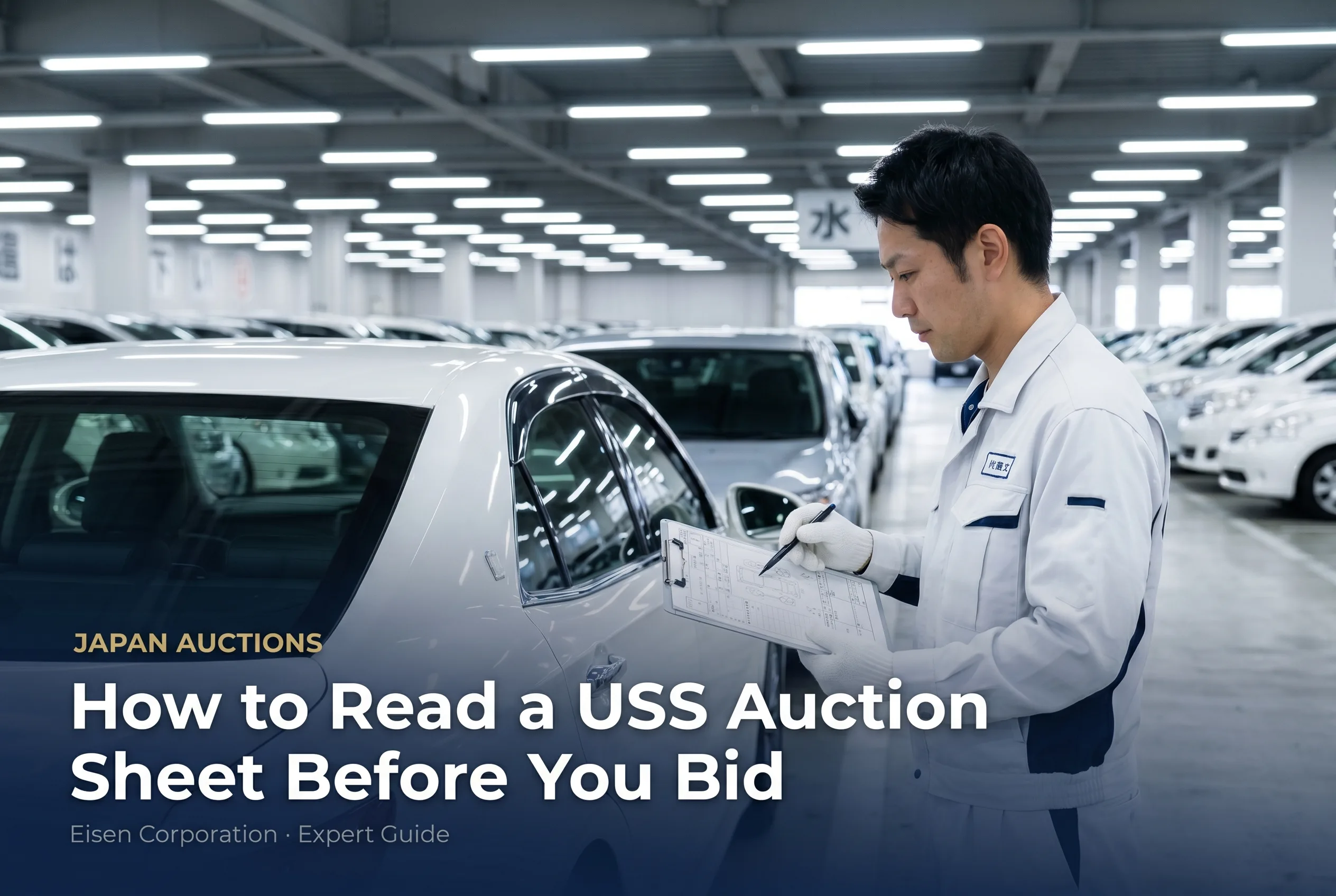
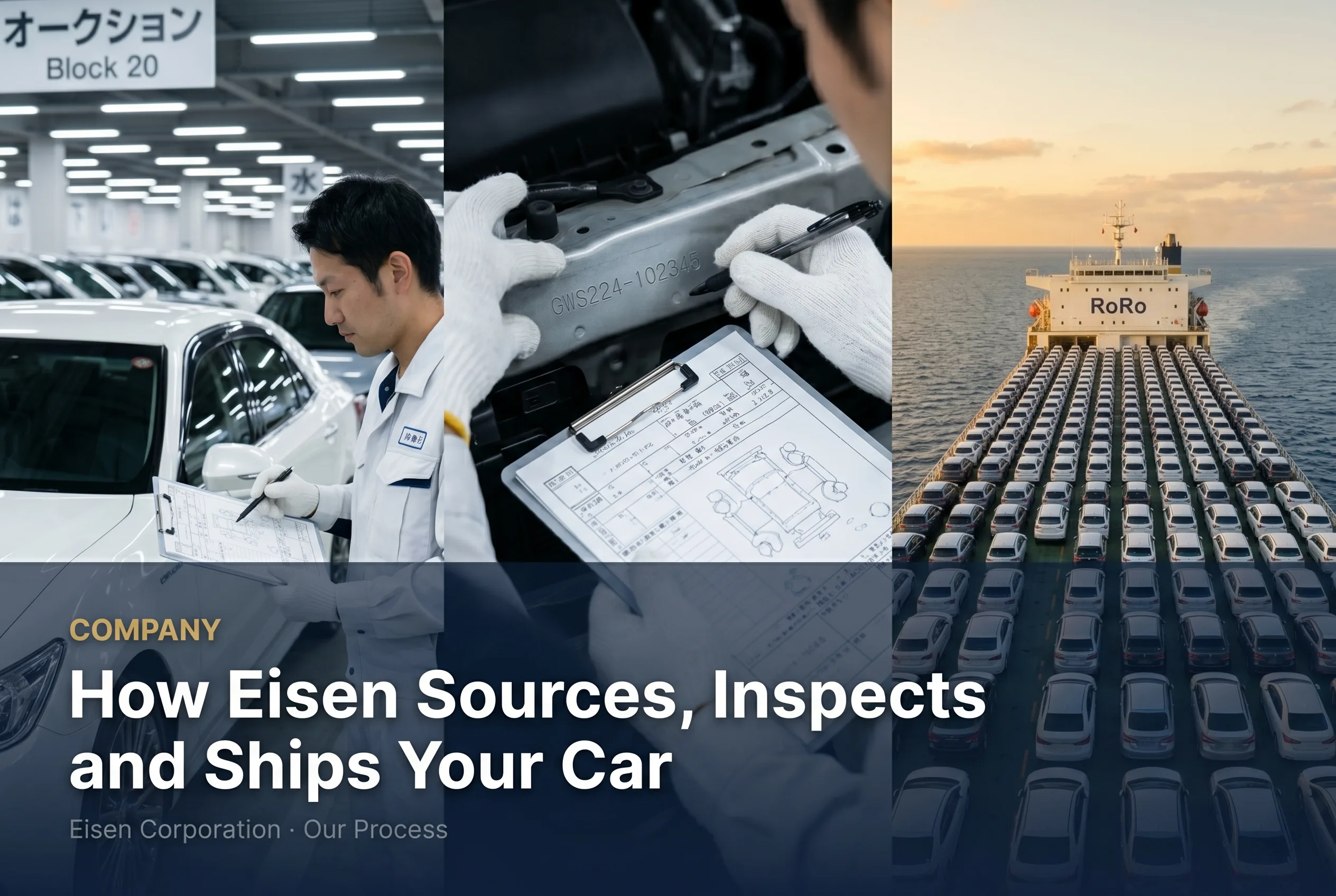
Every vehicle we shortlist is reviewed in full before we present it to you. We read the complete auction sheet, examine every photo available, check the damage diagram against the photos, and translate any inspector notes. Vehicles with undisclosed issues, suspicious grade markings, or damage patterns inconsistent with the stated grade are removed from consideration before you ever see them.
You receive a curated shortlist - not a raw dump of auction results.
Step 3: Bidding on Your Behalf
Once you approve a vehicle, we bid on your behalf on auction day. You set a maximum bid and we manage the auction strategy - timing the bid correctly and avoiding the common mistake of overbidding early and driving the price up unnecessarily.
Japanese auctions move quickly. Lanes run at a pace of one vehicle per minute or faster, and decisions need to be made in real time. Our team on the ground knows how each auction house operates and bids accordingly.
If your vehicle is outbid, we revert to the shortlist immediately and present the next best available option from the same auction week - minimising delays to your order.
Step 4: Post-Auction Verification and Pre-Export Inspection
After a successful bid, the vehicle is collected from the auction yard and transported to our pre-export facility. Before anything is packed or booked onto a vessel, the car goes through a physical verification check.
This check confirms:
- The vehicle matches the auction sheet description
- No damage has occurred during yard storage or transport from the auction
- All keys, documents, and accessories are present
- The chassis number matches the paperwork exactly
For higher-value vehicles or on client request, we arrange a full pre-export inspection by an independent third-party inspector. The report is shared with you in full - photographs, condition notes, and any findings - before the vehicle is loaded.
If a significant discrepancy is found between the auction sheet and the actual vehicle condition, we raise a formal complaint with the auction house. Japanese auction houses have structured dispute resolution processes and will compensate for undisclosed damage where a valid claim is submitted. We handle this process on your behalf at no additional cost.
Step 5: Deregistration and Export Documentation
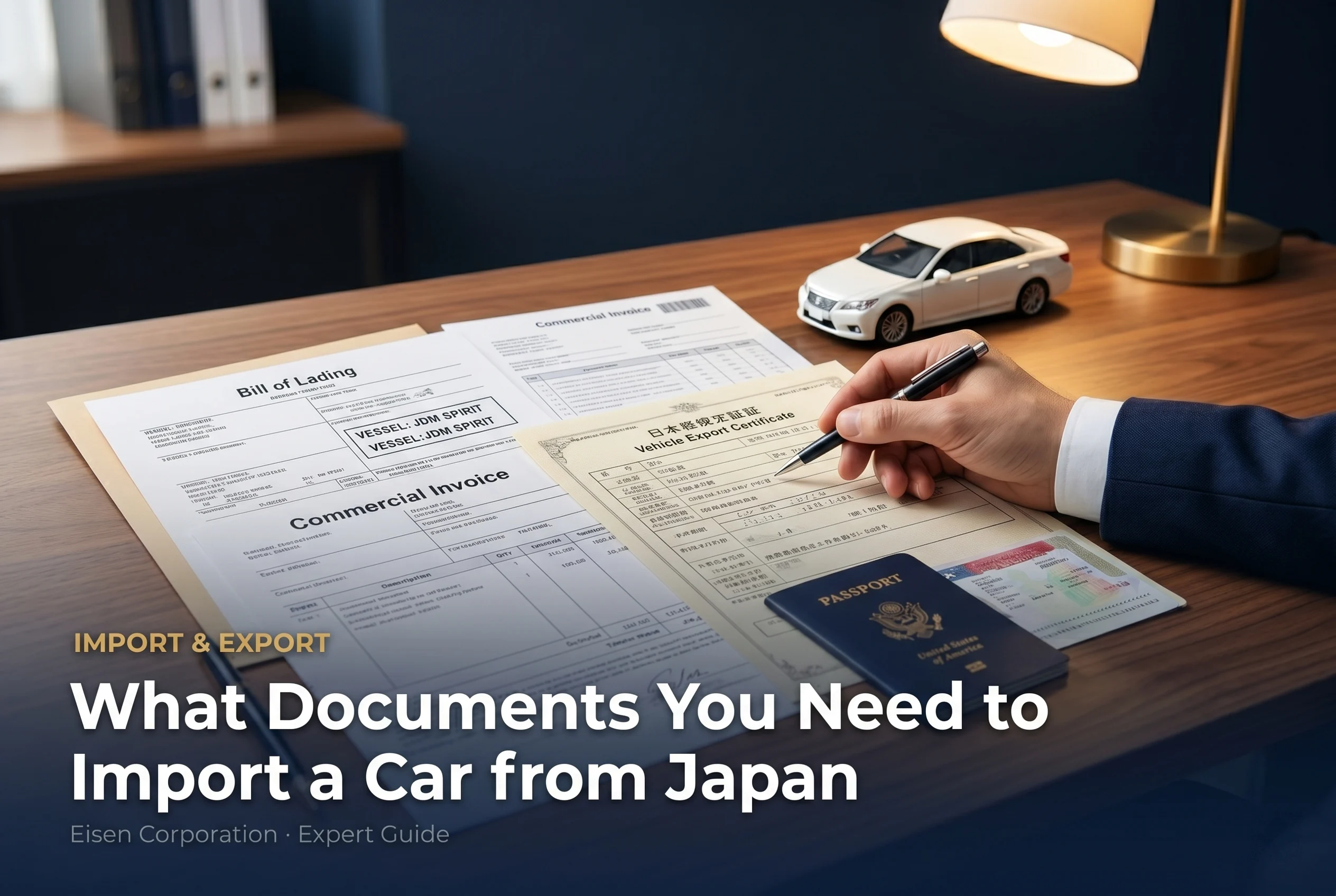
Before any vehicle can legally leave Japan, it must be deregistered from Japan's vehicle registry. This produces the Export Certificate - one of the most critical documents in the entire import process.
Eisen handles all deregistration paperwork directly with Japan's Land Transport Office. Once the Export Certificate is issued, we prepare the complete document set for your shipment:
- Export Certificate (Deregistration Certificate)
- Commercial Invoice
- Bill of Lading
- Packing List
- Marine Insurance Certificate
- Original Auction Sheet
Every document is checked for accuracy before the vessel departs. Errors in shipping documents are the single most common cause of customs delays at destination ports - we eliminate that risk before the car leaves Japan.
Step 6: Booking and Loading
Eisen works with established shipping lines operating regular RoRo and container services from Japan's major export ports - Osaka, Nagoya, Yokohama, and Kobe.
We book the vessel, confirm loading dates, and arrange marine insurance covering the vehicle from the moment it is loaded in Japan to arrival at your destination port.
Once the vehicle is loaded and the vessel departs, we send you the full document pack - Bill of Lading, commercial invoice, insurance certificate, export certificate, and auction sheet - digitally, before the vessel arrives. This gives you and your local clearing agent everything needed to prepare the customs declaration in advance, avoiding delays the moment the ship docks.
Step 7: Shipment Tracking and Arrival Support
After departure, we provide regular shipment updates - vessel name, expected arrival date, and any schedule changes flagged by the shipping line. You are never left wondering where your vehicle is.
When the vessel approaches your destination port, we follow up to confirm your local clearing agent has the full document set and is ready to submit the import declaration on arrival. This coordination step is often overlooked by other exporters - and it is frequently the difference between a vehicle that clears in three days and one that sits at port for three weeks.
Why This Process Matters
Every step in this process exists to protect one thing - the accuracy of what you receive versus what you paid for.
Japan's auction system is genuinely excellent. The grading is reliable, the inspection standard is high, and the volume of quality vehicles available every week is unmatched anywhere in the world. But it is still a system operated by humans, and mistakes happen - undisclosed damage, document errors, loading damage, customs complications.
The value Eisen brings is not just access to Japan's auctions. It is the experience, attention, and accountability applied at every step between the auction hall and your port.
When you import through Eisen, you are not buying blind. You are buying with a team behind you.
Start Your Next Order
Tell us what you are looking for - model, market, budget, and timeline - and our team will come back with a curated shortlist from current auction stock within 24 hours.
Contact us through the website or reach out directly to our export team to get started.